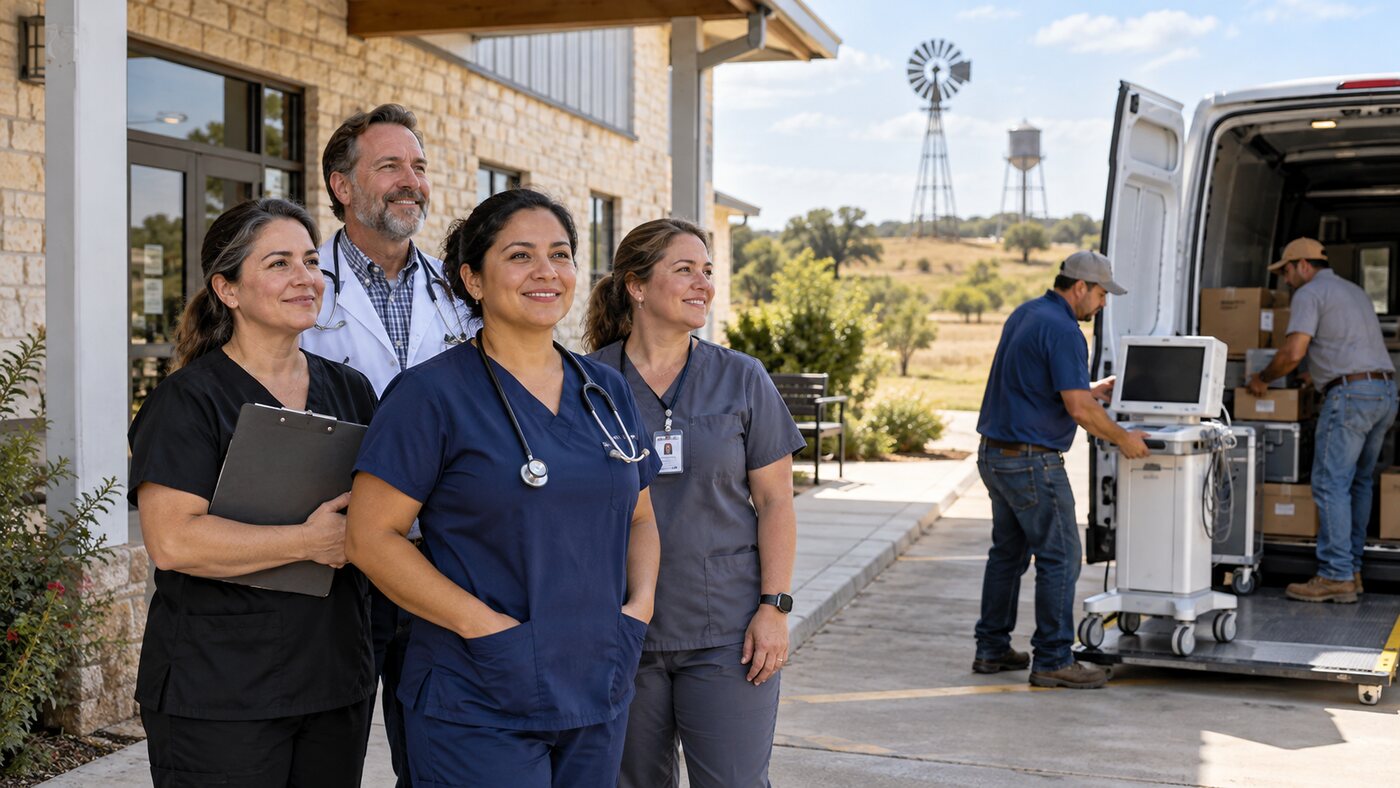
Texas plans to direct $8,145,444.89 to 28 rural health providers, but the money is not yet in recipients’ hands. Contracts must be finalized before funding becomes available.
The Texas governor’s office announcement says the Rural Texas Strong grants will support three kinds of work: chronic disease programs, health workforce recruitment and retention, and replacement of aging medical equipment or improvements to existing facilities.
That distinction matters. This is a planned award under a larger federal program, not a completed construction list or proof that every proposed service has started.
Rural Texas Strong grants by the numbers
| Measure | Official figure | What it means |
|---|---|---|
| Provider awards | $8,145,444.89 | Planned grants announced for 28 rural providers |
| Average per provider | About $290,909 | Daily Quill calculation if divided evenly; actual awards may differ |
| Texas first-year federal award | $281,319,360.67 | Broader Rural Health Transformation funding received by HHSC |
| Five-year federal estimate | $1.4 billion | Estimated statewide program total over five years |
| Federal share | 100% | Rural Texas Strong is federally funded, subject to requirements |
The provider grants equal about 2.9% of Texas’ first-year federal award. That comparison shows the announced awards are one part of a much larger plan. It does not indicate how the rest of the first-year money will be divided.
The simple average in the table is useful only for scale. The state did not say that each provider will receive the same amount, so readers should not treat $290,909 as an individual award.
What the three initiatives cover
| Initiative | Intended use | Details to watch |
|---|---|---|
| Make Rural Texans Healthy Again | Chronic disease and health outcomes | Which local programs address diabetes, heart disease, respiratory disease or obesity |
| Next Generation of the Small Town Doctor and Team | Recruit, train and retain workers | Which communities receive physician, emergency medical or other workforce support |
| Infrastructure and Capital Investments for Rural Texas | Equipment and existing facilities | Which purchases or building improvements are included after contracting |
The official announcement identifies the program categories but does not provide a start date for each project. It also does not promise a new hospital, emergency room or clinic in every community represented by a recipient.
People looking for a specific local benefit should wait for the final contract scope. A provider name alone cannot establish which service, piece of equipment or workforce position will be funded.
The broader state plan contains six initiatives, while this round advances three of them. The money comes through the federal Rural Health Transformation Program, and continued funding depends on compliance with program requirements.
Readers can follow additional public-health records on The Daily Quill’s Health and Wellness desk. State funding decisions with local consequences also appear in Community and Public Services coverage.
What rural patients and providers should watch next
The next meaningful records are finalized contracts, provider-specific award amounts and project schedules. Those documents should answer the questions this announcement cannot: what each provider will do, when work begins and how residents can use any new service.
Texas says future public notices and procurement opportunities will be distributed through its GovDelivery notifications. Providers interested in contracts should use the official HHSC Rural Health Transformation channels rather than an unsolicited grant offer.
For patients, the announcement does not change an appointment, insurance network or emergency-care option today. The practical test will come when the state and recipients publish local implementation details. Until then, the confirmed result is an $8.1 million planned allocation to 28 providers across three defined Rural Texas Strong grant priorities.