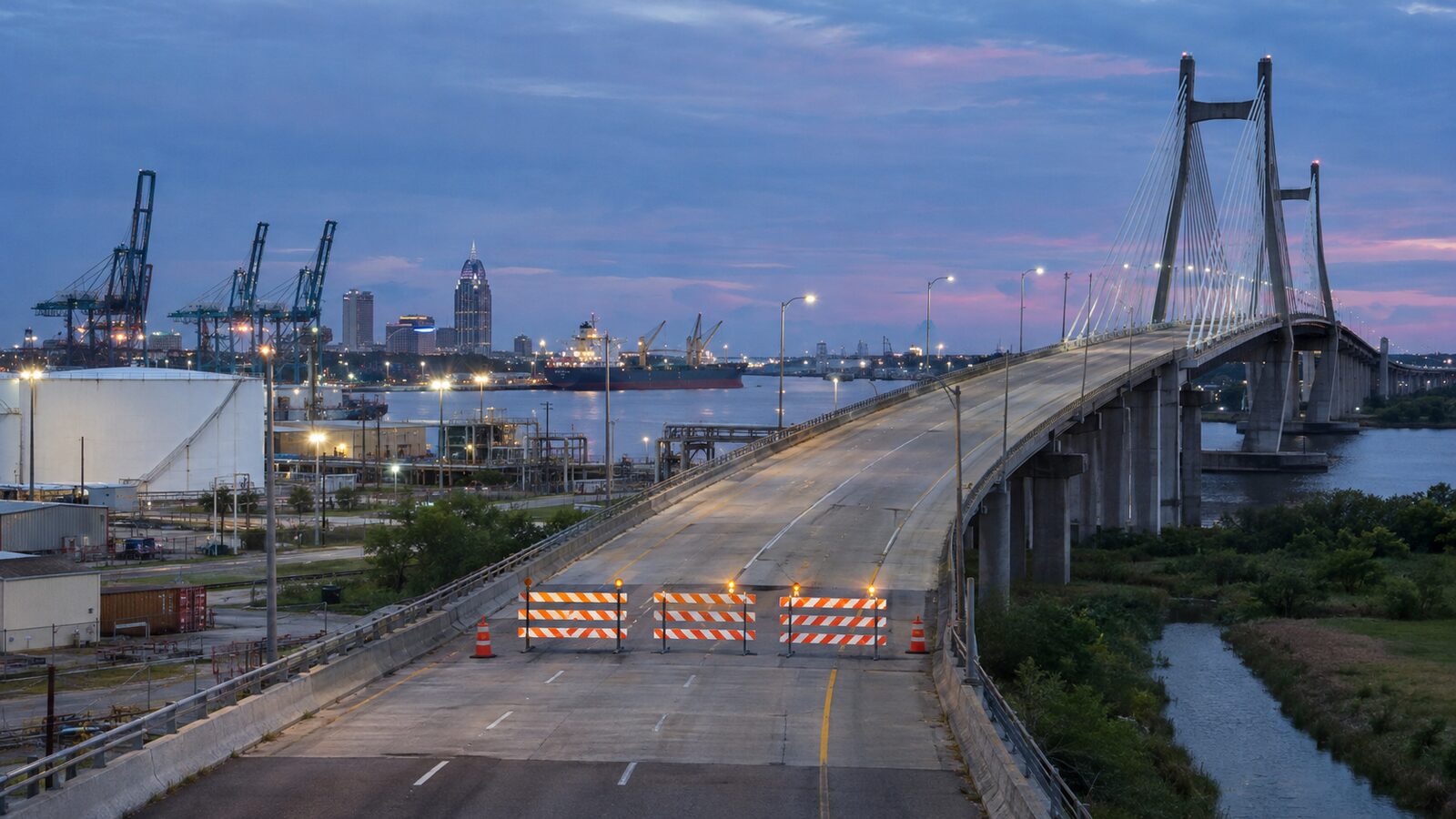
Cochrane Causeway closure on US-90 ALT begins Saturday night, Nov. 7, and the correct detour depends on the vehicle. Ordinary and standard commercial traffic can use I-10, while hazardous-material and other permitted loads must follow a longer signed route using I-10, SR-59 and I-65.
The Alabama Department of Transportation notice sets the closure from 8 p.m. Saturday until 8 a.m. Sunday, Nov. 8. A contractor will replace the northern industrial pipe bridge spanning the roadway.
Which Cochrane Causeway closure detour applies
| Vehicle or trip | Access during the closure | Official route or limit |
|---|---|---|
| Passenger vehicle | No through passage at the work area | Use I-10 or another legal alternate |
| Standard commercial load | No through passage | Use I-10 |
| Eastbound hazmat or permitted load | Causeway and Africatown Bridge unavailable | Take I-65 to SR-59, then return to I-10 |
| Westbound hazmat or permitted load | Causeway and Africatown Bridge unavailable | Leave I-10 at Exit 44 for SR-59 north, take I-65 south and return to I-10 |
| Nearby resident or business traffic | Local access may continue beyond perimeter points | Cannot pass through the pipe-bridge work area |
| Emergency vehicle | Passage allowed through the work area | Follow on-site control |
ALDOT says the outer closure points extend from the Bankhead Tunnel on the east side to US-43 on the west side. Those perimeter points do not mean every driveway inside the area is inaccessible. Local trips can continue until the active pipe-bridge closure blocks the route.
Why the hazmat route is different
Hazardous-material transports cannot use the Africatown Bridge or the US-90 causeway during the closure. That removes the shorter alternatives available to ordinary drivers and explains the I-65 and SR-59 loop.
Operators should follow the signed detour even if a consumer mapping app suggests a shorter path. Routing software may not account for vehicle permits, hazardous-material restrictions or the temporary bridge rule.
The closure is scheduled overnight, but drivers should allow time on both sides of the published window. Equipment access and traffic control will be active before the industrial pipe bridge can be removed and replaced. Weather or field conditions can also change the reopening time.
A check before leaving
Drivers should confirm the live route before departure through ALGO Traffic, especially if the trip reaches Mobile near the 8 p.m. closure or 8 a.m. reopening. Commercial operators should also compare the signed route with their permit conditions.
This is a complete road closure at the work area, not a lane reduction. A person traveling between the Bankhead Tunnel and US-43 should not expect to cross the pipe-bridge location, even if local access remains open elsewhere inside the perimeter.
The window crosses two calendar days, which can confuse overnight shifts and Sunday deliveries. The Cochrane Causeway closure is especially consequential for permitted carriers because the alternate is not simply the nearest open bridge. Operators can also review The Daily Quill’s Alabama oversize-permit holiday schedule for a separate Nov. 11 interruption. Neither report replaces a permit or signed detour, but together they identify two planning checkpoints.
Passenger drivers should distinguish the Cochrane Causeway from the ordinary US-90 causeway and Africatown Bridge when reading directions. The notice names access limits for all three in the hazmat context, but the pipe-bridge work area on US-90 ALT is the active closure described here. Saving the official detour before leaving can prevent a late reroute. The Cochrane Causeway closure should leave the trip plan only after ALDOT or live traffic data confirms reopening.
For dispatchers, the safest handoff is a vehicle-class instruction rather than a single copied map link. A passenger-car route is not proof that a placarded load can use the same bridge. Record the closure window in Central time, attach the ALDOT notice to the trip file and have the driver follow field signs if they differ from a saved route.
The next useful update is ALDOT’s confirmation that US-90 ALT reopened Sunday morning. Until that appears, the published closure clock and vehicle-specific detours control the trip plan.