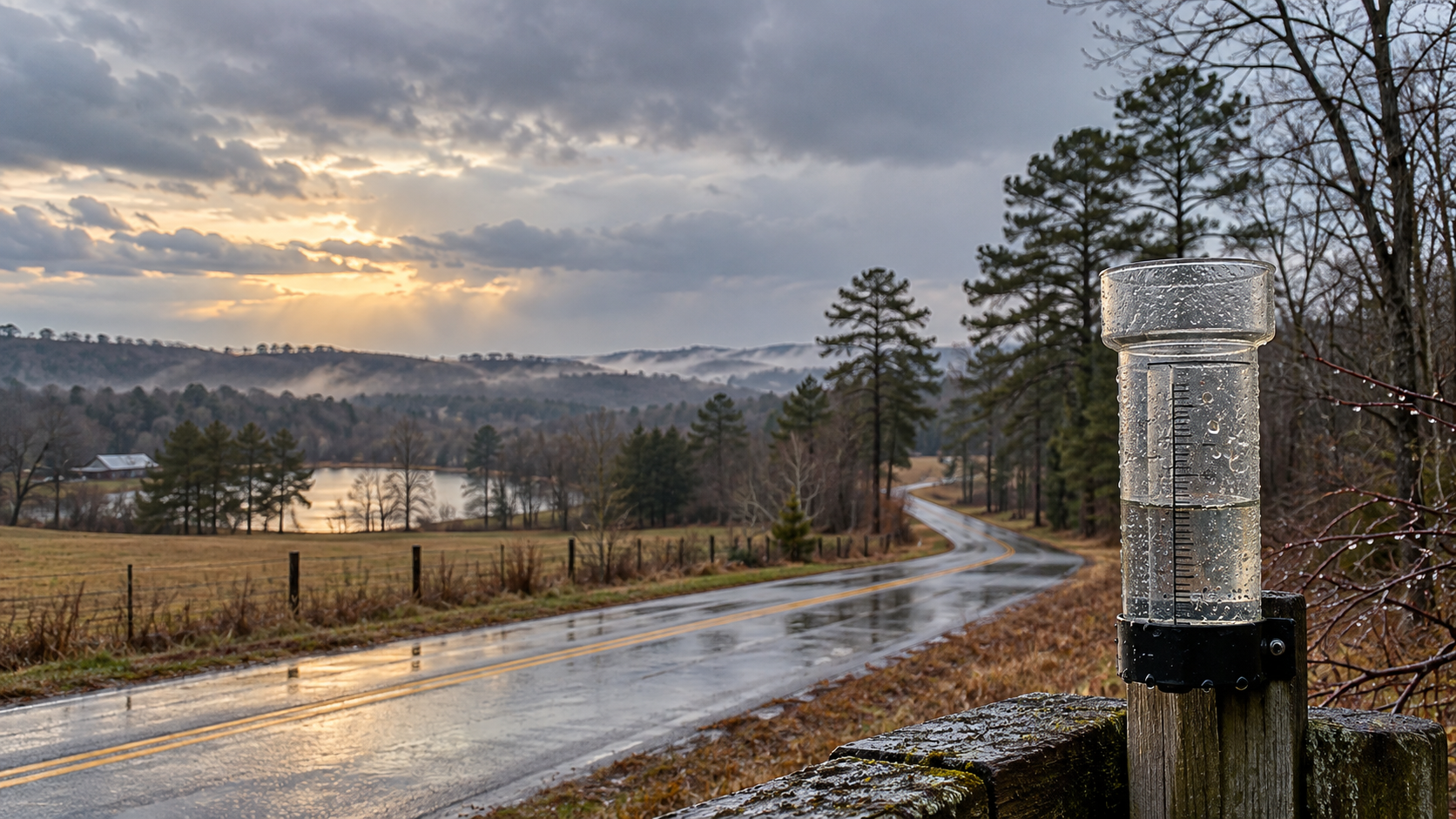
The Alabama winter outlook for 2026-27 favors wetter-than-average conditions during December through February as a strong El Nino influences weather patterns across the United States. NOAA’s Oct. 15 outlook also favors drought improvement across the Southeast, while the temperature signal is less decisive than the precipitation signal.
That seasonal signal does not predict how much rain will fall in a particular Alabama town, which dates will be wet or whether an individual storm will become severe. It describes probabilities across a three-month period, not a daily forecast.
NOAA also sees the region’s drought picture easing substantially before February. Conditions can change, so residents, farmers and local officials should continue using short-range forecasts and current drought information for decisions.
Alabama winter outlook 2026-27 at a glance
| Planning question | NOAA’s current signal | What it does not mean |
|---|---|---|
| Will the season be wet? | Above-normal precipitation is favored across the Southeast. | It does not predict rain in every Alabama county or every week. |
| Will the season be warm or cold? | Across much of the Southeast, CPC gives the near-normal category the highest probability for the season-wide average. | A three-month average does not rule out a freeze or brief cold outbreak. |
| Will drought improve? | NOAA favors drought improvement or removal across much of the Southeast before February. | Improvement can vary locally and does not eliminate flash-flood risk. |
| When does the outlook change? | NOAA says the next monthly update is due Nov. 19. | The Oct. 15 outlook should not replace current local forecasts and warnings. |
This comparison separates the three signals readers most often combine. NOAA’s precipitation, temperature and drought maps measure different outcomes and should not be treated as a single forecast.
What the Alabama winter outlook shows
The NOAA U.S. Winter Outlook favors wetter-than-average conditions across the South, Southeast and East Coast. In the Climate Prediction Center’s Oct. 15 discussion, the near-normal category has the highest probability over a broad southeastern region because the forecast tools do not agree on a stronger warm or cold tilt.
For Alabama readers, the practical message is that the Alabama winter outlook raises the odds of a wetter season without guaranteeing continuous rain or ruling out cold snaps. Seasonal averages can contain long dry stretches, brief heavy-rain events and sharp temperature changes.
The agency plans its next monthly update for Nov. 19. That update may refine the probabilities as the atmosphere and Pacific Ocean evolve.
Why El Nino matters this winter
El Nino is the warm phase of a recurring climate pattern in the tropical Pacific. It can shift the jet stream south and east, increasing the odds of stormier weather across parts of the southern United States.
NOAA’s Oct. 8 ENSO discussion says El Nino continues to strengthen and is likely to remain strong to very strong through January-March 2027. The agency estimated an 83% chance of conditions reaching a very strong level during October-December.
Those probabilities strengthen the broad signal behind the Alabama winter outlook, but historical patterns are not guarantees. Other atmospheric patterns can amplify, weaken or temporarily reverse the typical El Nino influence.
Residents should not interpret “wetter than average” as a promise that every county receives beneficial rain. Heavy precipitation on very dry soil can run off quickly, and localized flooding remains possible even during a season that improves drought overall.
Does the Alabama winter outlook predict snow?
The outlook does not provide an Alabama snow forecast for winter 2026-27. NOAA sorts the season’s total precipitation and average temperature into above-normal, near-normal or below-normal categories, but it does not project a seasonal snowfall total.
An overall wetter signal also does not mean the added precipitation will fall as snow. The temperature profile of a particular storm, the storm track and local ground conditions become clearer only at shorter ranges. NOAA says individual snow events generally cannot be predicted more than about a week in advance.
Readers searching for Alabama snow information should use forecasts from their local National Weather Service office when a specific system enters the reliable forecast window. The seasonal outlook is useful for preparation, not for naming a snow date or expected accumulation.
A practical Alabama winter checklist
As an early planning prompt, the Alabama winter outlook can help households review simple preparations. Residents can clear leaves from drains and gutters, check that weather alerts are enabled, and review routes that commonly flood. Drivers should avoid assuming that a familiar low-water crossing is safe after heavy rain.
Property owners can inspect roofs, outdoor drainage and exposed pipes before a storm is imminent. Farmers and gardeners should compare seasonal guidance with county-level forecasts, soil conditions and advice from local Extension offices rather than making decisions from a national map alone.
Emergency supplies should reflect Alabama’s varied winter hazards: heavy rain, power outages, occasional freezing temperatures and rapidly changing road conditions. A basic plan should include flashlights, charged backup batteries, necessary medications, drinking water and a way to receive warnings when mobile service is limited.
What to watch next
Its value increases when readers combine the Alabama winter outlook with shorter-range products. NOAA’s Climate Prediction Center updates monthly and three-month outlooks, while local National Weather Service offices issue forecasts and warnings for specific hazards.
As winter approaches, compare the national seasonal signal with forecasts from the National Weather Service offices serving Birmingham, Mobile, Huntsville and Tallahassee. Their coverage areas together include Alabama counties from the Tennessee Valley to the Gulf Coast.
Ultimately, the Alabama winter outlook is a probability-based planning tool, not a prediction of every storm. Readers can follow The Daily Quill’s Central Alabama coverage for local public-service reporting and United States coverage for additional federal forecasts.
Seasonal outlooks describe probabilities and are not substitutes for current local forecasts or emergency warnings.