
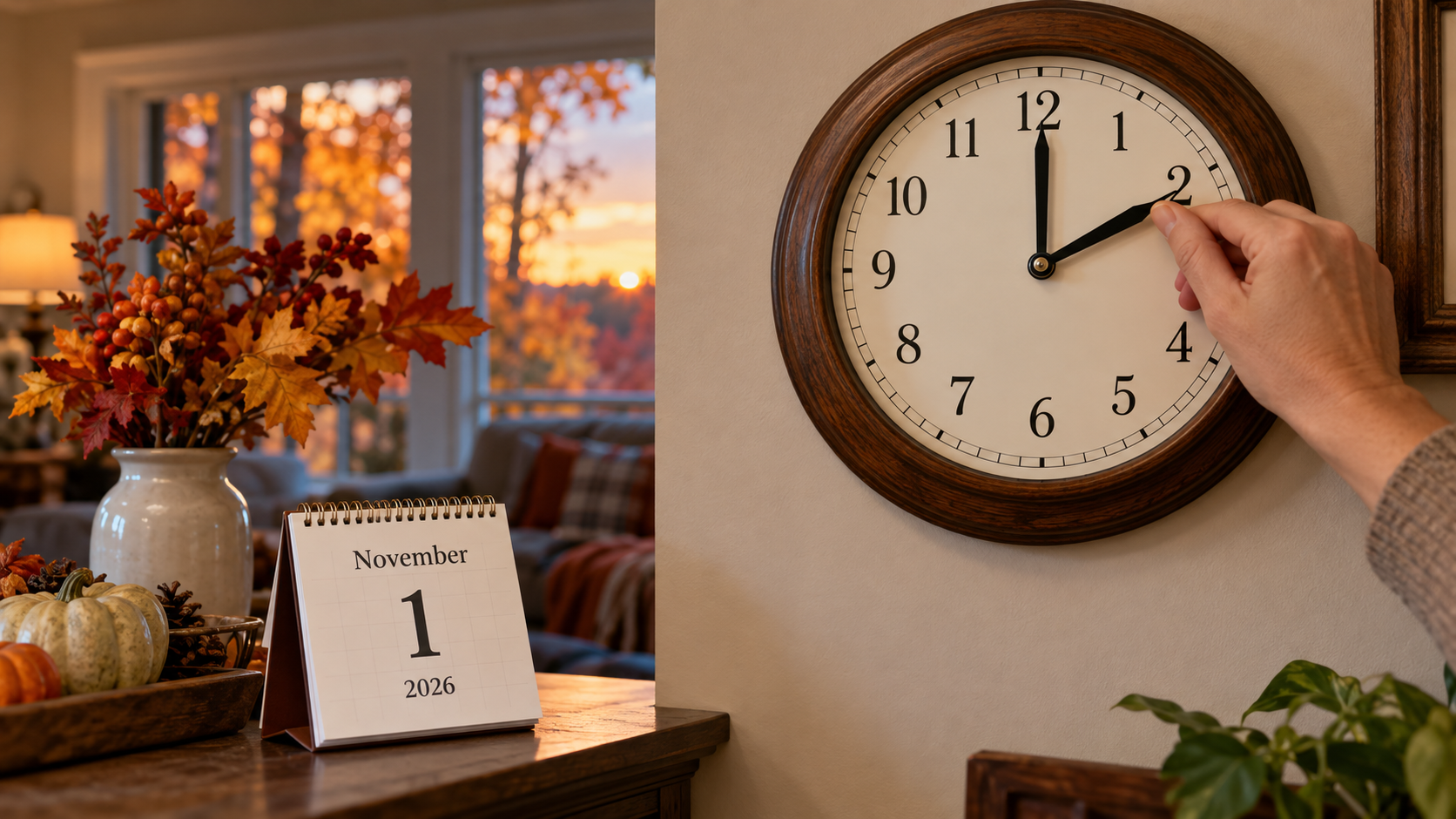
Daylight saving time ends in Alabama at 2 a.m. local time on Sunday, Nov. 1, 2026. At that moment, clocks move back one hour to 1 a.m., repeating the hour and giving the calendar day 25 hours.
Most internet-connected phones, computers and televisions should update automatically. Wall clocks, ovens, microwaves, vehicle dashboards and some medical or household devices may require a manual change.
The switch returns Alabama to Central Standard Time. Residents can use the weekend as a prompt to review appointments, overnight work schedules and any device that depends on a manually entered time.
When daylight saving time ends in Alabama
The National Institute of Standards and Technology lists daylight saving time in 2026 as running from March 8 through Nov. 1. Under the federal rule, the fall change occurs at 2 a.m. on the first Sunday in November.
When daylight saving time ends, the hour from 1 a.m. to 2 a.m. occurs twice. That detail matters for overnight employees, transportation schedules, automated logs and anyone arranging a pickup or appointment during the repeated hour.
Alabama observes the federal daylight-saving schedule. The U.S. Department of Transportation oversees the national time-zone rules and notes that Hawaii, most of Arizona and several U.S. territories do not observe the seasonal change.
People traveling across time zones should check the local rule at their destination instead of assuming every state changes clocks.
Which clocks need attention
Before daylight saving time ends, make a quick inventory of devices that display or use time. Automatic updates are common, but they are not universal.
Check:
- Wall clocks, alarm clocks and watches.
- Ovens, microwaves and coffee makers.
- Vehicle dashboards and navigation systems.
- Irrigation timers, outdoor lighting and security equipment.
- Cameras, appliances and older thermostats.
- Any household device whose schedule is entered manually.
If an automatic device shows the wrong time after the change, confirm its time-zone setting before manually moving the clock. A device set to Eastern Time, Mountain Time or an incorrect daylight-saving option may remain one hour off.
Appointments, travel and overnight work
Because daylight saving time ends early Sunday, most daytime plans will simply occur on standard time. The repeated hour creates more potential confusion for overnight activity.
Workers whose shifts cross 2 a.m. should confirm how the employer records the repeated hour. Travelers should use the time printed by the carrier or reservation system and verify any connection that crosses a time-zone boundary.
For early Sunday appointments, deliveries or transportation, write the time with the words “standard time” if there is any chance of ambiguity. Calendar apps normally adjust automatically, but an event created with a fixed UTC offset can behave differently from one created in the Central Time zone.
The change also affects the relationship between Alabama and places that do not observe daylight saving time. Confirm call times with people in Arizona, Hawaii or U.S. territories after Nov. 1.
A simple Saturday-night checklist
The easiest way to prepare when daylight saving time ends is to handle manual clocks before going to bed Saturday, Oct. 31.
- Set manual clocks back one hour.
- Leave internet-connected devices on automatic time unless there is a known problem.
- Confirm Sunday alarms and calendar entries.
- Check travel, work and caregiving schedules that cross the repeated hour.
- Verify timed lights, thermostats and other household schedules after the change.
Do not change an automatic clock twice. If a phone is moved back manually before it performs its own update, the displayed time may be two hours wrong.
After daylight saving time ends, sunrise and sunset occur about one clock-hour earlier than they did the day before. Actual daylight continues changing gradually with the season; only the way clocks label the hour changes abruptly.
The next nationwide clock change is scheduled for March 14, 2027, when daylight saving time begins again in participating states. Readers can follow The Daily Quill’s United States coverage for additional federal calendar and public-service updates.
Check official schedules for transportation, employment and time-sensitive services affected by the repeated hour.