Radio and television audiences are included in a planned nationwide Emergency Alert System test at 1:20 p.m. Central on Tuesday, November 17. Separate National Weather Service tsunami communications checks scheduled for the same date are not intended as public notifications.
That distinction matters when reading notices about Gulf Coast alert tests. The two federal records describe different recipients and channels. The public EAS clock should not be copied onto the NWS checks, whose notice does not give a public transmission time.
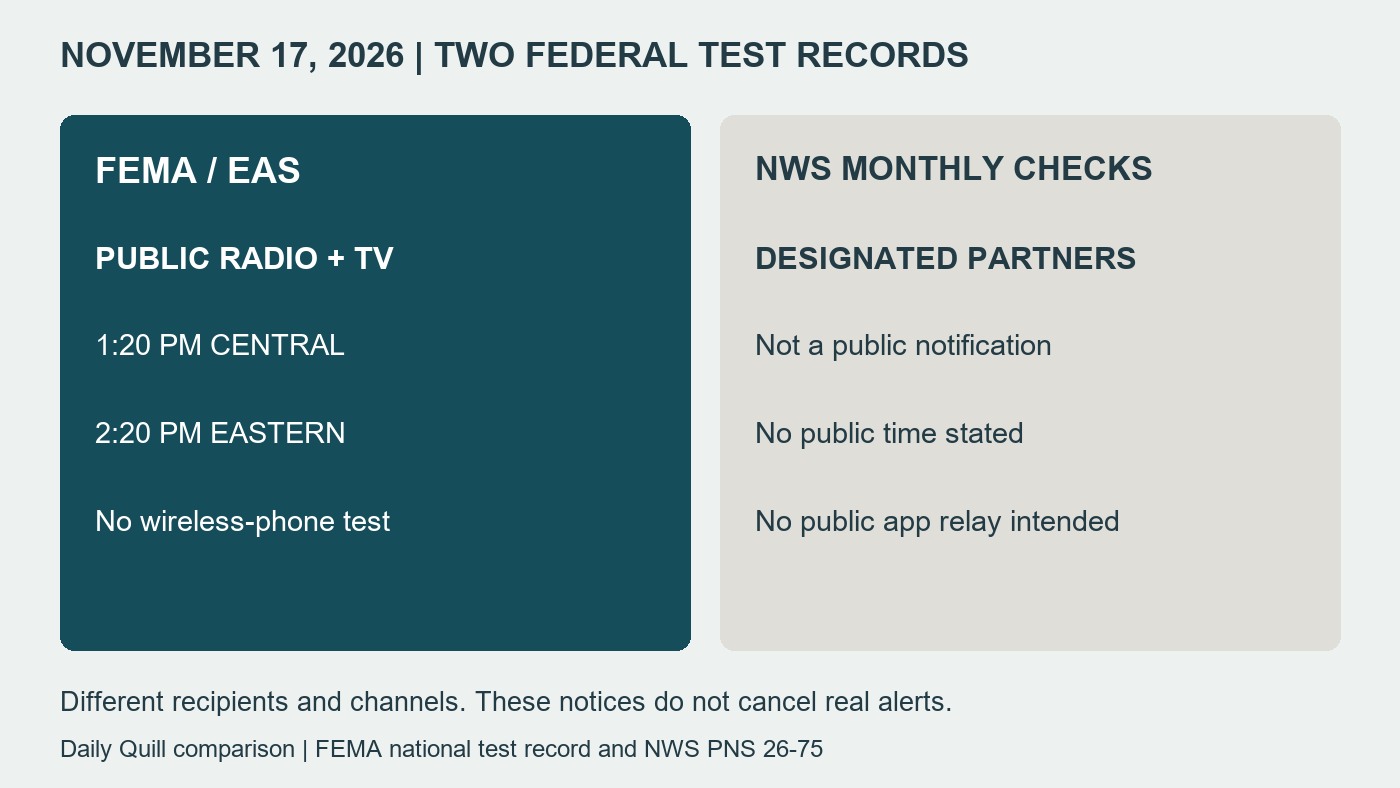
Gulf Coast alert tests compared by recipient
| Record | Intended audience | Channel or delivery scope | Time stated for November 17 |
|---|---|---|---|
| FEMA nationwide EAS test | The public through participating providers | Radio, TV and other EAS distribution providers | About 2:20 p.m. Eastern, or 1:20 p.m. Central |
| NWS monthly tsunami communications checks | Designated warning and dissemination partners | Agency communications systems | No public test time stated in PNS 26-75 |
FEMA’s national-test page describes an interruption of regular radio and television programming lasting approximately one minute. Individual stations may use English, Spanish or both and may present the message differently because their equipment and audiences differ.
Those variations do not turn the announcement into a test of every alert channel. FEMA’s questions and answers explicitly exclude Wireless Emergency Alerts to phones from this year’s exercise. The FAQ distinguishes it from the wireless testing conducted in 2023.
Use the local clock for the public broadcast
Among these Gulf Coast alert tests, FEMA’s public broadcast is the one with a published clock time. The table converts that single transmission, using November 17 standard-time offsets.
| Time zone | Local clock for the planned EAS transmission |
|---|---|
| Eastern Standard Time | 2:20 p.m. |
| Central Standard Time | 1:20 p.m. |
| Mountain Standard Time | 12:20 p.m. |
| Pacific Standard Time | 11:20 a.m. |
Readers across Alabama, Mississippi, Louisiana, Florida and Texas should use the applicable local zone, rather than assume every Gulf South community shares a clock. The broadcast time is not a guarantee that each provider will display an identical screen at an identical instant.
In Starkville, Mississippi State’s emergency-information page also carries FEMA’s reminder that this is a radio-and-TV test rather than a mobile-phone test. That reminder concerns the federal exercise; it does not establish that every campus alert tool is being tested.
The NWS record names warning partners, not public recipients
NWS Public Information Statement 26-75, issued November 12, describes monthly checks for East and Gulf Coast warning partners. It says these test messages should not be relayed to the public by third-party services or apps and will not appear on tsunami.gov.
Its second sector lists twelve offices located in Alabama, Florida, Louisiana and Texas:
| Office location state | Listed NWS offices |
|---|---|
| Texas | Brownsville, Corpus Christi and Houston |
| Louisiana | Lake Charles and New Orleans |
| Alabama | Mobile |
| Florida | Jacksonville, Key West, Melbourne, Miami, Tallahassee and Tampa Bay Area |
These are office locations, not county coverage. The record announces no public tsunami drill or evacuation.
A scheduled test is separate from an operational alert
The useful comparison in these Gulf Coast alert tests is audience first, then channel and time. A radio or TV test announcement does not show that a phone’s wireless-alert settings were tested. Likewise, the nonpublic NWS record should not be treated as a second public broadcast schedule.
Real weather products remain separate. The Volusia alert guide compares the rainfall, river and coastal notices in that Florida area. The Community and Public Services desk carries related local reporting. Neither test notice establishes that a warning elsewhere can be disregarded.
FEMA says the public is not being asked to take action for its announced test. Its FAQ gives December 3 as the backup date if conditions require a postponement. Before the planned 1:20 p.m. Central broadcast, check the current FEMA notice; do not infer a successful transmission or a change of date from the schedule alone.