The Florida flood survey is now open for business owners reporting physical or economic losses from the 2026 fall flooding in 15 counties. The form helps the state measure recovery needs, but Florida’s own survey page says it is not an application for loans or other resources.
FloridaCommerce and the State Emergency Response Team activated the assessment on Nov. 5. Businesses should select “2026 Fall Flooding” in the event menu at FloridaDisaster.biz.
Florida flood survey county list
| Region | Counties named by FloridaCommerce |
|---|---|
| Atlantic and east-central | Brevard, Indian River, Martin, Palm Beach, Seminole, St. Lucie, Volusia |
| Inland and south-central | DeSoto, Glades, Hardee, Hendry, Highlands, Lake, Okeechobee |
The table reorganizes the state’s 15-county list for readability; it does not expand eligibility. A business outside those counties should check the live incident menu before filing because the state may revise the response area.
What to gather before starting
The live survey asks for more than a business name and address. A prepared owner can reduce guesswork by assembling records in five groups.
| Record group | Examples requested by the state form |
|---|---|
| Operating status | Open, closed, alternate location, alternate hours and anticipated reopening |
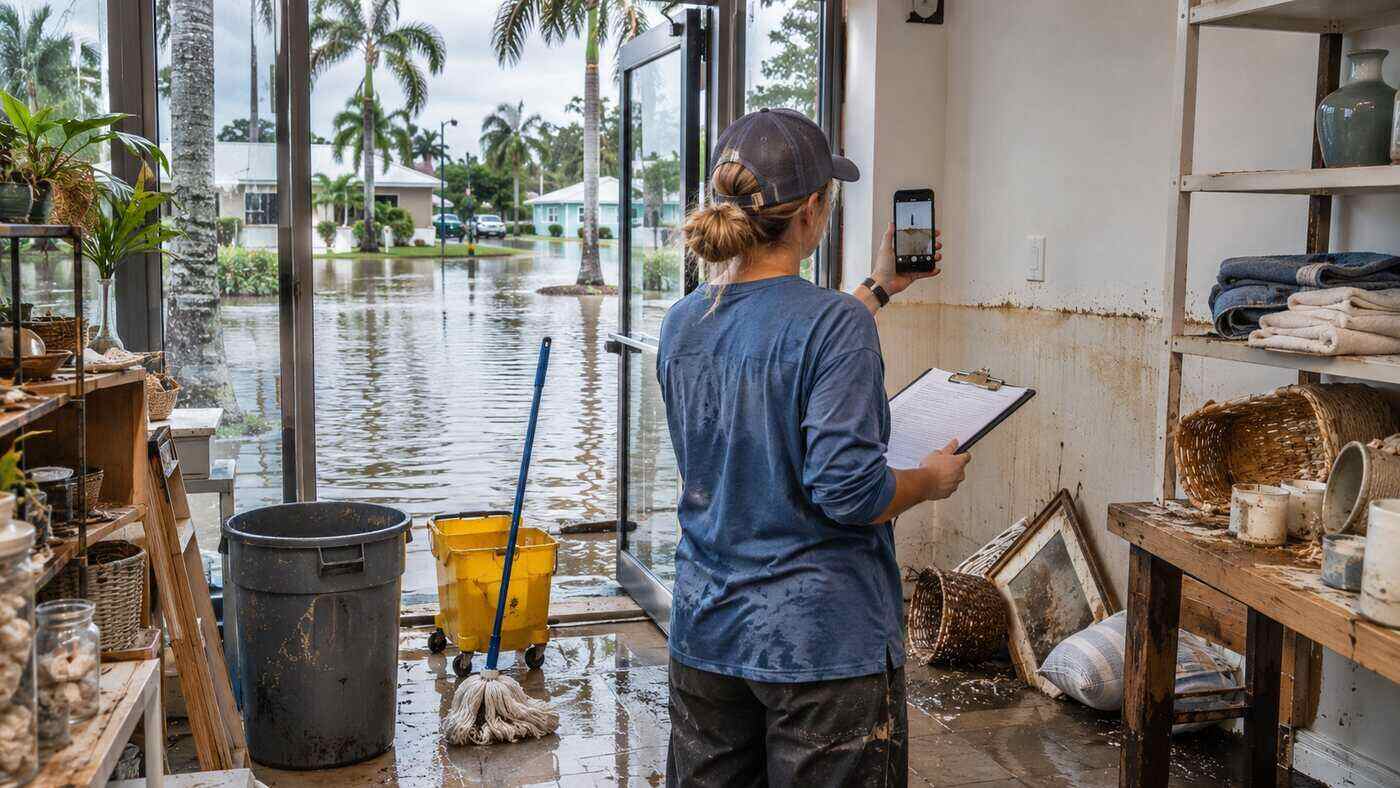
| Physical loss | Inventory, real estate, equipment, debris removal and floodwater depth |
| Economic loss | Disaster-period revenue, prior-year comparison and estimated total loss |
| Workforce effect | Current employees, temporary layoffs and permanent layoffs |
| Coverage and needs | Insurance types, FEMA registration, space needs and requested recovery information |
The survey also asks whether access, power, suppliers, employees or other problems are delaying reopening. Estimates should be identified as estimates and supported with photos, invoices, payroll records or other contemporaneous material when available.
For owners, the Florida flood survey provides one place to record those categories in the state’s incident assessment.
The form is not an aid application
Florida’s assessment page states that submitting information does not apply for resources. The state uses responses to understand damage and recovery needs, and an agency may contact a business that requests information.
Owners seeking a loan or another program must follow the separate application instructions for that resource. Completing the assessment should not be treated as a substitute for a deadline-bearing recovery application.
The form also warns that survey responses are public records and may be released upon request. A filer should provide accurate business information but avoid placing unrelated confidential material in narrative fields. The state form requests contact details so agencies can follow up when the owner asks for assistance information.
Separate the evidence folder from the form itself. Photos can be organized by room or equipment type, revenue comparisons should use the same dates in both years, and payroll counts should distinguish temporary from permanent layoffs. That preparation helps the Florida flood survey capture a consistent estimate without turning the submission into an unstructured document dump.
Because the Florida flood survey is a public-record assessment, owners should review narrative fields for unrelated personal or confidential information before submitting.
If the loss estimate changes after cleanup or an insurer’s inspection, the owner should keep the original calculation and the revised figure in the business recovery file. The public survey does not explain an amendment process, so a business that needs to correct a submitted response should use the listed hotline rather than submit a duplicate without guidance.
How to complete the assessment
- Open the official Business Damage Assessment Survey.
- Select “2026 Fall Flooding” as the incident.
- Confirm the damaged business location is in one of the 15 named counties.
- Enter operating status and the best available physical and economic loss estimates.
- Record insurance, staffing and reopening effects.
- Choose whether the business wants information about recovery services.
- Review the public-record notice before submitting.
- Save a copy or confirmation for the business’s recovery file.
FloridaCommerce lists a private-sector hotline at 850-815-4925, open daily from 8 a.m. to 5 p.m. The agency also accepts recovery questions at ESF18@em.myflorida.com.
The Daily Quill’s community services desk tracks official application windows and service changes. Its recent Florida disaster-loan guide covers a separate lending process and should not be confused with this assessment.
Together, the Florida flood survey can support the state’s damage picture, while the separate loan guide explains a funding application with its own eligibility rules and deadline.
FloridaCommerce has not published a closing date for this specific survey notice. Businesses should file while the incident remains available and recheck the official page for changes rather than assume the form will stay open indefinitely.